Hepburn Shire has a great range of art in public places. These commissioned artworks by highly respected artists respond creatively to the spaces and places, people and culture of the region and enhance the Shire.
In Commissioning works, Council is guided by the following:
Current public artworks
Aunty Marilyne Nicholls in collaboration with Canberra Glassworks 2024.
The Mechanics Trentham
Aunty Marilyne is a Multi Clans woman; Dja Dja Wurrung, Wadi Wadi, Barapa Barapa, Yorta Yorta, Latji Latji, Jupagulk, and Ngarrindjeri Master Weaver.
Fish traps were an important technology for my people. Plants that I usually weave with are from fresh water such as Boort Lakes. For weaving practice, you need to know about the environment, about the waterway, what's in the landscape and watching it from season to season, being aware of the disruptive triggers. I often leave the seeds behind in the landscape to ensure that there is plenty of grass available when needed. I learnt weaving from my grandmother, Mother and Father and I will continue to share my knowledge with future generations.
Canberra Glassworks
The artwork symbolises a blend of traditional cultural weaving practice with contemporary glassmaking practices. Together the artwork invites viewers to contemplate the intersection of traditional and contemporary practice, the elements of heat and water, nature and technology.
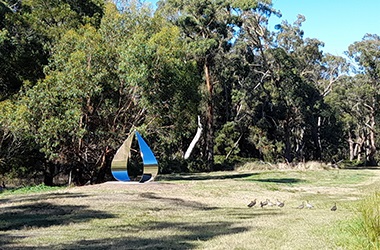
“Drop” by Yu Fang Chi. Installed at Glenlyon in March 2023. Commissioned by Hepburn Shire Council, 2021.
Crafted from stainless steel, brass and concrete, Drop responds to the precious water resource of the Glenlyon Dam, mineral springs and the river. It is installed at the edge of the dam, and pays homage to the natural beauty of the area and its contextual relationship with water. It sits beautifully in the surrounding bush environment.
The plinth at the base of the work features inlaid brass circles and the Dja Dja Wurrung word ‘wanyarram’ (which means water), acknowledging and paying respect to the Dja Dja Wurrung as the Traditional Owners of the land and waters.
It’s a short walk from the entry road, in a location that also allows the work to be viewed across the water. The work reflects the artist’s focus on the natural environment.
Artist, Yu Fang Chi, talks about The Drop
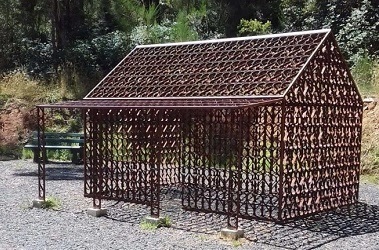
“Cottage” by Jason Waterhouse. Lake Daylesford, Daylesford. Commissioned by Hepburn Shire Council, 2015.
Located at Lake Daylesford, “Cottage” is made of decorative, hand-wrought iron inspired by patterns seen around Daylesford. It draws on the architecture of miners' cottages during the gold rush era and seeks to remind us of modern Daylesford’s historical foundations. “Cottage” was completed in 2015 by Glenlyon artist, Jason Waterhouse.
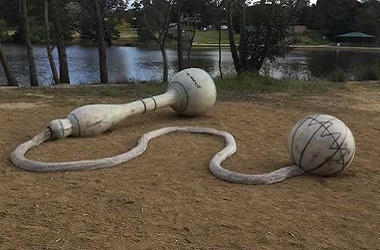
“My Dearest” by Mark Cuthbertson. Calambeen Park, Creswick. Commissioned by Hepburn Shire Council, 2016.
Mark Cuthbertson’s “My Dearest” is made from concrete and polyurethane and resembles a nostalgic cup-and-ball child’s toy. The work references the hardship and loss experienced by families during the gold rush era. “My Dearest” presents a symbolic gesture, evoking memories of the past by referencing a sentimental item or cherished keep sake to provoke reflections on connection and loss.
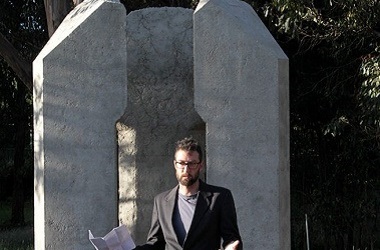
“Inter-stelae” by Michael Needham. Stony Creek Reserve, Trentham. Commissioned by Hepburn Shire Council, 2017.
Inter-stelae is a monument to cultural presence within an ancient landscape. It acknowledges that the site on which it sits is imbued with layers of cultural history and memory. As a memorial, it allows for a re-imagining of the natural environment and invites an appreciation of a land that is always bigger and older than its occupants. Photo: Richard Ryan.
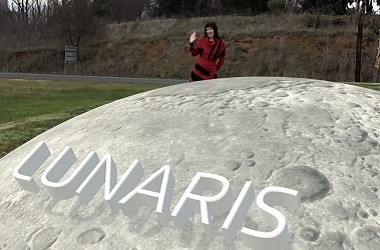
“Lunaris” by Joanne Mott. Bailey Street Skate Park, Clunes. Commissioned by Hepburn Shire Council, 2018.
“Lunaris” considers the site’s relationship with the moon. To experience the artwork, audiences are invited to explore both the sculptural installation, and augmented reality imagery of the moon using a smart phone or other device. Drawing on cues from the local environment, such as its geological uniqueness and social history, Lunaris combines art forms, both old and new, from the sculpting of earthworks, which dates back to Neolithic times, to Augmented Reality (AR), a new media technology. By accessing the Augmented Reality application, viewers can explore the moon with their smart device, translating the circular paved arena into a moonscape alive with lunar layers.
Please note we are having some issues with the app. However, once it is again available please follow the steps below to load and operate the Augmented Reality app:
Engaging with 'Lunaris' augmented reality app onsite:
Augmented reality engagement relies on your device “reading” the unique tiling pattern on the arena. It must be clear of objects (including people!).
- Start by standing centrally on the grass mound.
- Point your device at the centre of the paved arena.
- Hold still to engage Lunaris AR. It may help to raise and tilt device to gain a more aerial view of the arena.
- Keep your device locked into the arena by always pointing your camera toward the pavement.
- Walk around the arena while viewing the Lunaris AR.
Extra tips:
- Shadows, glare, rain, objects and light conditions impede engagement and effectiveness of AR tracking.
- Do not face into the sun.
- Re-engage by taking in a larger pavement area with your camera.